
US State Department 2021 Trafficking in Persons Report
Forced labour main human trafficking crime in Malaysia, U.S. says
REUTERS
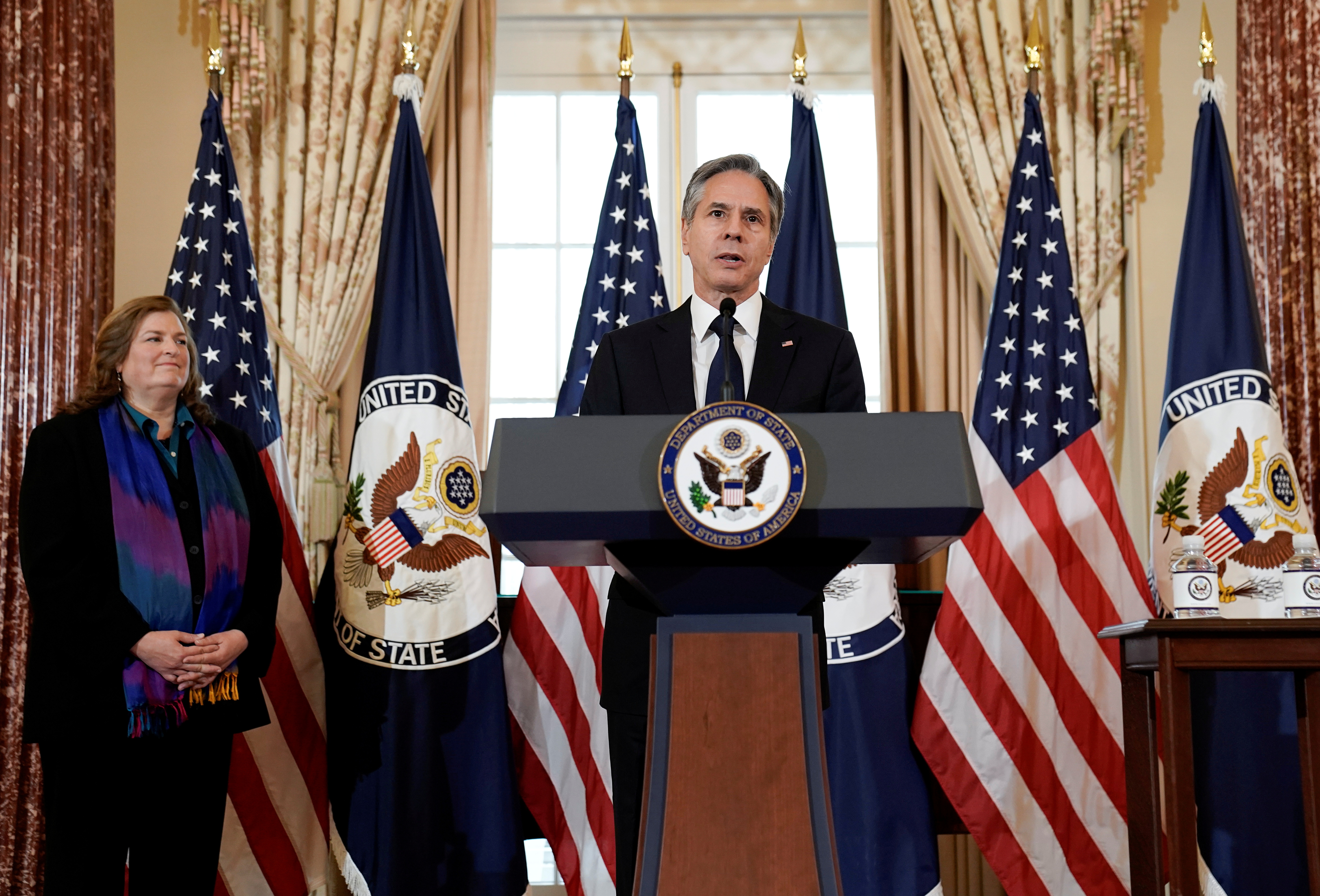
U.S. Secretary of State Antony Blinken delivers remarks on the release of the 2021 Trafficking in Persons (TIP) Report as Kari Johnstone, acting director of Office to Monitor and Combat Trafficing In Persons, listens at the State Department in Washington, U.S., July 1, 2021. REUTERS/Ken Cedeno/Pool
KUALA LUMPUR/BANGKOK, July 2 (Reuters) - Malaysia's predominant human trafficking crime is forced labour, the U.S State Department said on Friday, after downgrading the Southeast Asian country to the worst tier in its annual report on human trafficking.
Malaysia fell to 'Tier 3' in this year's closely watched Trafficking in Persons (TIP) report as it continued to conflate human trafficking and migrant smuggling crimes, and did not adequately address or criminally pursue credible allegations on labour trafficking, the report said. read more
Malaysia's home ministry has not commented publicly on the report and did not immediately respond on Friday to a request from Reuters for comment.
In a teleconference with reporters, Acting Director of the State Department's trafficking office Kari Johnstone said the overwhelming majority of trafficking victims in Malaysia are migrant workers, of which there are an estimated 2 million who are documented, and a greater number undocumented.
"The sectors primarily where we see the greatest forced labour – which is the predominant form of the crime within Malaysia – includes on palm oil and agriculture plantations, in construction sites, in the electronics, garment and rubber product industries," said Johnstone.
The downgrade comes after a string of complaints by rights groups and U.S. authorities over alleged exploitation of migrant workers in plantations and factories. read more
Neighbouring Thailand was downgraded to 'Tier 2 Watchlist' in the report, which found a high number of trafficking victims subjected to forced labour in the fishing and agriculture industry.
"Trafficking victims are also subjected to sex trafficking in brothels, massage parlours, bars, karaoke lounges, hotels and private residences," Johnstone said.
Thailand's foreign ministry called the downgrade disappointing and said it does not fairly reflect significant efforts and progress it has made to combat human trafficking.
It said it has taken several measures, including granting workers from Cambodia, Laos, and Myanmar an extended period of stay during the coronavirus crisis.
"The TIP Report, after all, unilaterally makes an evaluation from the U.S' very own view and by no means represents any international standard," the ministry said in a statement.
Thailand has faced criticism from rights groups in recent months over a "bubble and seal" COVID-19 containment policy prohibiting migrant workers in factories and construction site from leaving their workplace during an outbreak. read more
Reporting by Mei Mei Chu and A. Ananthalakshmi in Kuala Lumpur and Chayut Setboonsarng in Bangkok; Editing by Martin Petty
.

REUTERS EXCLUSIVE
U.S. to downgrade Malaysia to worst tier in trafficking report -sources
Mei Mei ChuA. Ananthalakshmi
KUALA LUMPUR, July 1 (Reuters) - The U.S. State Department will downgrade Malaysia to the worst ranking in its closely watched annual report on human trafficking to be released later on Thursday, two sources familiar with the matter told Reuters.
The downgrade comes after a string of complaints by rights groups and U.S. authorities over the alleged exploitation of migrant workers in plantations and factories. read more
Malaysia will fall to 'Tier 3' after spending three years on the 'Tier 2 Watchlist' in this year's Trafficking in Persons (TIP) report, said the sources, who did not want to be identified as they were not authorised to talk to media.
The State Department ranks countries in Tier 3 for failing to comply with the minimum standards for eliminating trafficking or make significant efforts to comply. A Tier 3 ranking could affect Malaysia's access to some U.S. aid.
Malaysia's home ministry did not have an immediate comment. A senior police official told Reuters this week that forced labour was not a widespread problem. read more
The U.S. embassy in Kuala Lumpur declined to comment ahead of the report launch, scheduled for 1700 GMT on Thursday.
Reuters contacted the State Department, but could not reach a spokesperson outside of regular U.S. business hours.
The Southeast Asian nation has close to 2 million foreign workers, and rights groups say there are millions more who are undocumented.
It is also home to more than 170,000 registered refugees and asylum seekers, most of them Rohingya from Myanmar.
Migrant workers typically get to Malaysia by paying a high fee to recruitment agents in their home countries, which activists say leads to debt bondage.
Large organised crime syndicates are responsible for some instances of trafficking in Malaysia, the State Department said in its 2020 TIP report.
IMPORT BANS
In the past year, the United States has imposed import bans on three Malaysian companies over allegations of forced labour in their operations, including the world's top glove maker and two palm oil producers. read more
The glove maker, Top Glove (TPGC.KL), said in April it had resolved all indicators of forced labour found at its factories.
The other two firms hit with bans by the U.S. Customs and Border Protection agency - Sime Darby Plantation (SIPL.KL) and FGV Holdings (FGVH.KL) - said they had appointed auditors to evaluate their practices and would engage with the agency to address the concerns raised.
Independent migrant worker rights specialist Andy Hall welcomed the decision to downgrade Malaysia.
"The Government of Malaysia is a key actor that should take the lead to combat modern slavery and forced labour within its borders," he said.
Malaysia was in Tier 3 - the lowest ranking in the TIP report - until 2015, when it was upgraded to the Tier 2 Watch List, a move that drew criticism in both Malaysia and the United States.
The 2020 TIP report said that while Malaysia was taking steps to eliminate trafficking, official complicity undermined anti-trafficking efforts.
The number of labour trafficking investigations was also low compared to the scale of the problem, it said.
Reporting by Mei Mei Chu and A. Ananthalakshmi; Editing by Martin Petty and Andrew Heavens
Mei Mei ChuA. Ananthalakshmi
KUALA LUMPUR, July 1 (Reuters) - The U.S. State Department will downgrade Malaysia to the worst ranking in its closely watched annual report on human trafficking to be released later on Thursday, two sources familiar with the matter told Reuters.
The downgrade comes after a string of complaints by rights groups and U.S. authorities over the alleged exploitation of migrant workers in plantations and factories. read more
Malaysia will fall to 'Tier 3' after spending three years on the 'Tier 2 Watchlist' in this year's Trafficking in Persons (TIP) report, said the sources, who did not want to be identified as they were not authorised to talk to media.
The State Department ranks countries in Tier 3 for failing to comply with the minimum standards for eliminating trafficking or make significant efforts to comply. A Tier 3 ranking could affect Malaysia's access to some U.S. aid.
Malaysia's home ministry did not have an immediate comment. A senior police official told Reuters this week that forced labour was not a widespread problem. read more
The U.S. embassy in Kuala Lumpur declined to comment ahead of the report launch, scheduled for 1700 GMT on Thursday.
Reuters contacted the State Department, but could not reach a spokesperson outside of regular U.S. business hours.
The Southeast Asian nation has close to 2 million foreign workers, and rights groups say there are millions more who are undocumented.
It is also home to more than 170,000 registered refugees and asylum seekers, most of them Rohingya from Myanmar.
Migrant workers typically get to Malaysia by paying a high fee to recruitment agents in their home countries, which activists say leads to debt bondage.
Large organised crime syndicates are responsible for some instances of trafficking in Malaysia, the State Department said in its 2020 TIP report.
IMPORT BANS
In the past year, the United States has imposed import bans on three Malaysian companies over allegations of forced labour in their operations, including the world's top glove maker and two palm oil producers. read more
The glove maker, Top Glove (TPGC.KL), said in April it had resolved all indicators of forced labour found at its factories.
The other two firms hit with bans by the U.S. Customs and Border Protection agency - Sime Darby Plantation (SIPL.KL) and FGV Holdings (FGVH.KL) - said they had appointed auditors to evaluate their practices and would engage with the agency to address the concerns raised.
Independent migrant worker rights specialist Andy Hall welcomed the decision to downgrade Malaysia.
"The Government of Malaysia is a key actor that should take the lead to combat modern slavery and forced labour within its borders," he said.
Malaysia was in Tier 3 - the lowest ranking in the TIP report - until 2015, when it was upgraded to the Tier 2 Watch List, a move that drew criticism in both Malaysia and the United States.
The 2020 TIP report said that while Malaysia was taking steps to eliminate trafficking, official complicity undermined anti-trafficking efforts.
The number of labour trafficking investigations was also low compared to the scale of the problem, it said.
Reporting by Mei Mei Chu and A. Ananthalakshmi; Editing by Martin Petty and Andrew Heavens


